|
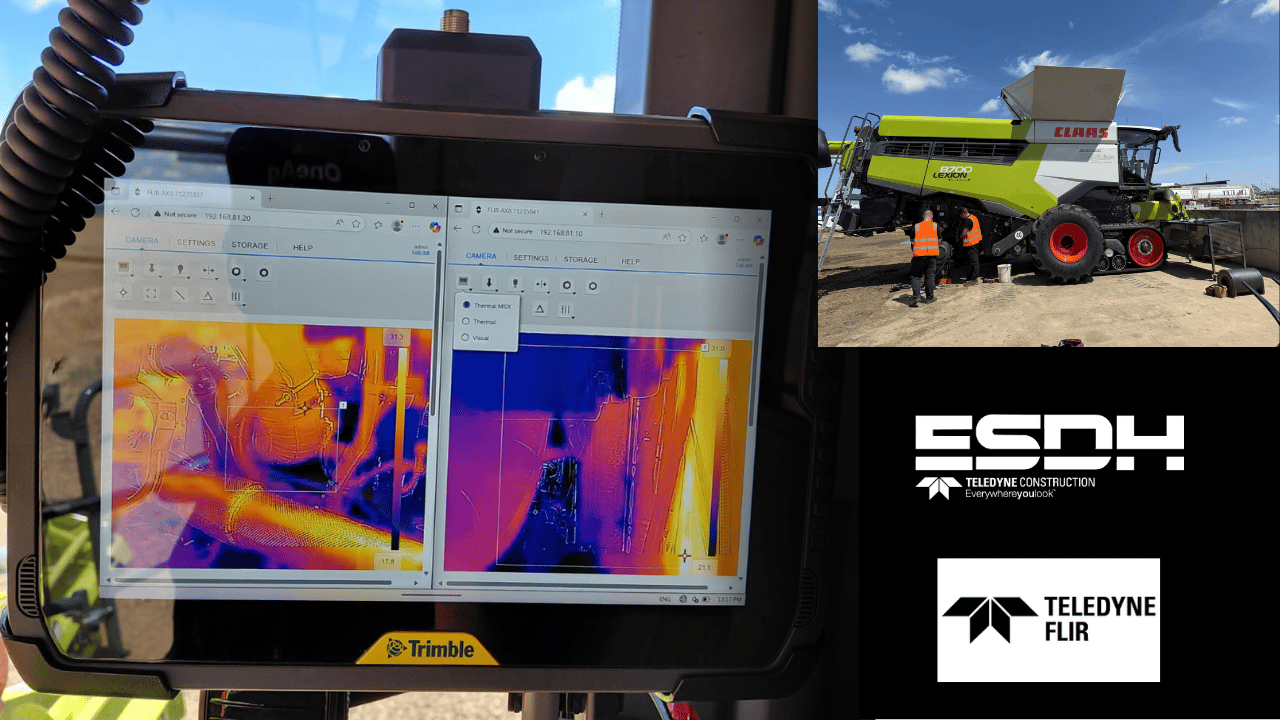
The OneAg team has been working on something very exciting. With hot, dry conditions setting in across many grain-growing regions, the risk of header and harvester fires is once again front of mind for farmers. To help tackle this challenge, we’ve partnered with technology experts at Teledyne FLIR to explore an early fire-detection solution using their advanced thermal-imaging sensor system.
Harvester fires can be caused by several factors: mechanical faults such as bearings, hydraulics, or brakes. Most often, they begin in the engine bay, where dust and debris are blown by cooling fans and can ignite on hot exhaust manifolds or turbos.
For grain growers, harvesters are among the most valuable and essential machines on the farm. That’s why keeping a close eye on machine temperature and operating conditions can make all the difference in preventing damage and potentially a fire.
By using FLIR thermal cameras, the operator can continuously monitor machinery heat levels with built-in alarms to detect potential fire risks before they escalate - helping protect their million-dollar investment. FLIR thermal cameras are widely trusted across industries, including wind turbine gearbox monitoring, electrical substation protection, industrial machinery inspections, and building energy audits. Their broad adoption underscores their reliability in detecting heat-related issues in critical assets. For more information, visit Early Fire Detection - ESDH Teledyne Construction.
Field Test: On-Farm Application:
Two cameras were installed on a customer’s harvester - one in the engine bay and one around the belt and bearings. The image shows a heat map after three hours of operation, with the engine bay reaching 128 °C. This demonstrates how thermal monitoring can provide early warning before heat levels reach critical levels.
This project is currently a proof of concept. The OneAg team is working hard behind the scenes to develop a reliable, field-ready solution to help reduce the risk of harvester and header fires.
Stay tuned for more updates, and all the best for a safe and successful harvest season.
For further information on harvest fire safety, visit the Country Fire Authority’s guide.
|